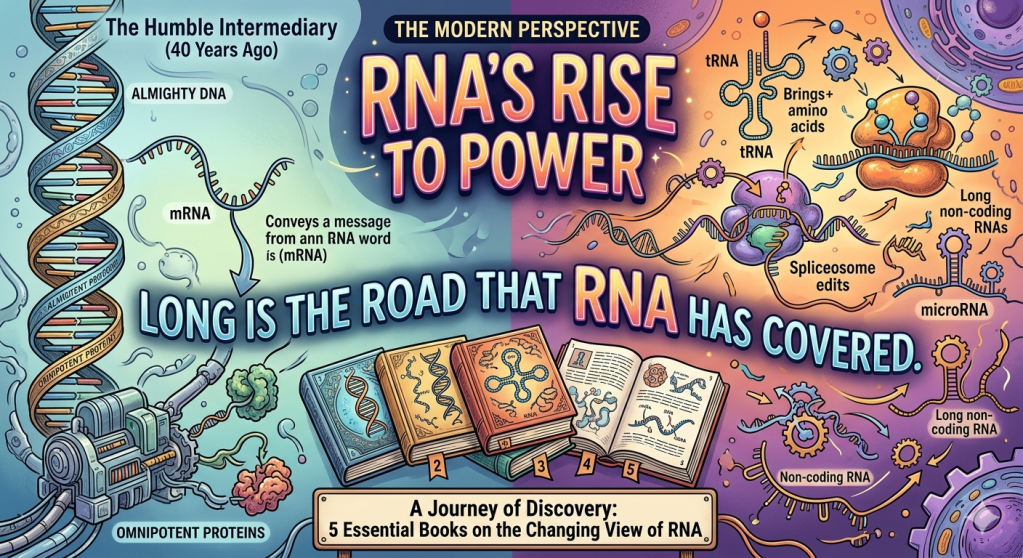
Long is the road that RNA has covered since scientists spoke of it merely as the humble intermediary between the almighty DNA and the omnipotent proteins.
To understand how our perspective has changed over the past 40 years, I have compiled a list of 5 books.
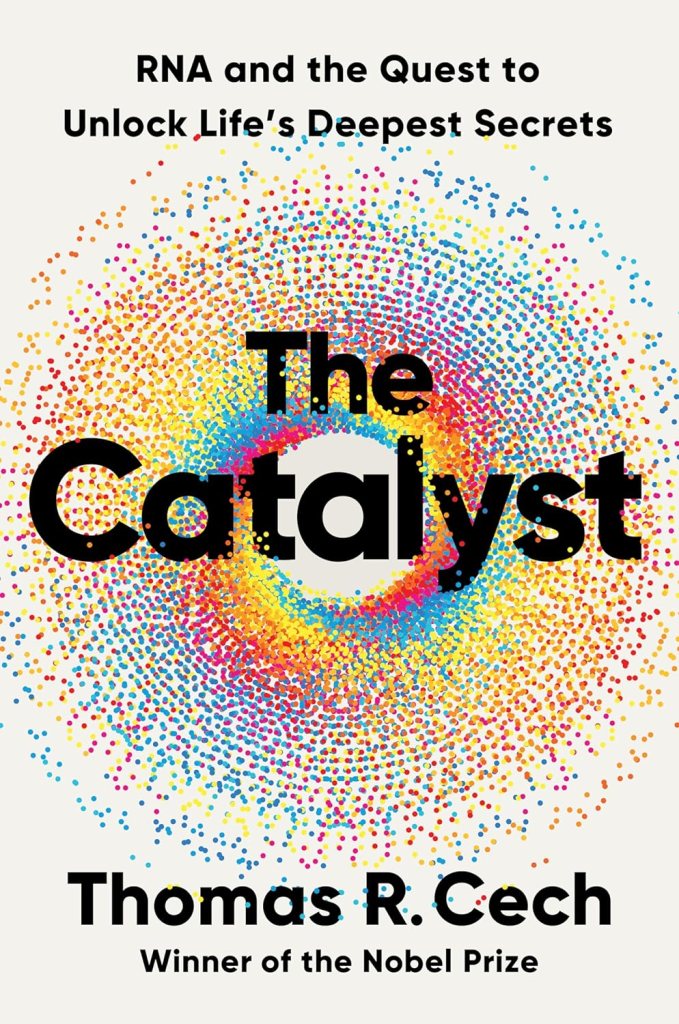
1. The Catalyst: RNA and the Quest to Unlock Life’s Deepest Secrets — Thomas R. Cech (2024)
Synopsis: For decades, RNA were seen as the passive intermediary between DNA and proteins. Then, in the 1980s, a few mavericks showed that it can catalyse chemical reactions. The discovery of RNAs with enzymatic properties, the ribozymes, sparked a revolution in molecular biology. Here, we learn how the first ribozymes were discovered, how they work and how they may be the origin of life itself.
Author’s bio: winner of the 1989 Nobel Prize in Chemistry for discovering the first ribozyme.
Related posts on WritinGenomics: sequencing of first RNA, decoding the first triplet of the genetic code.
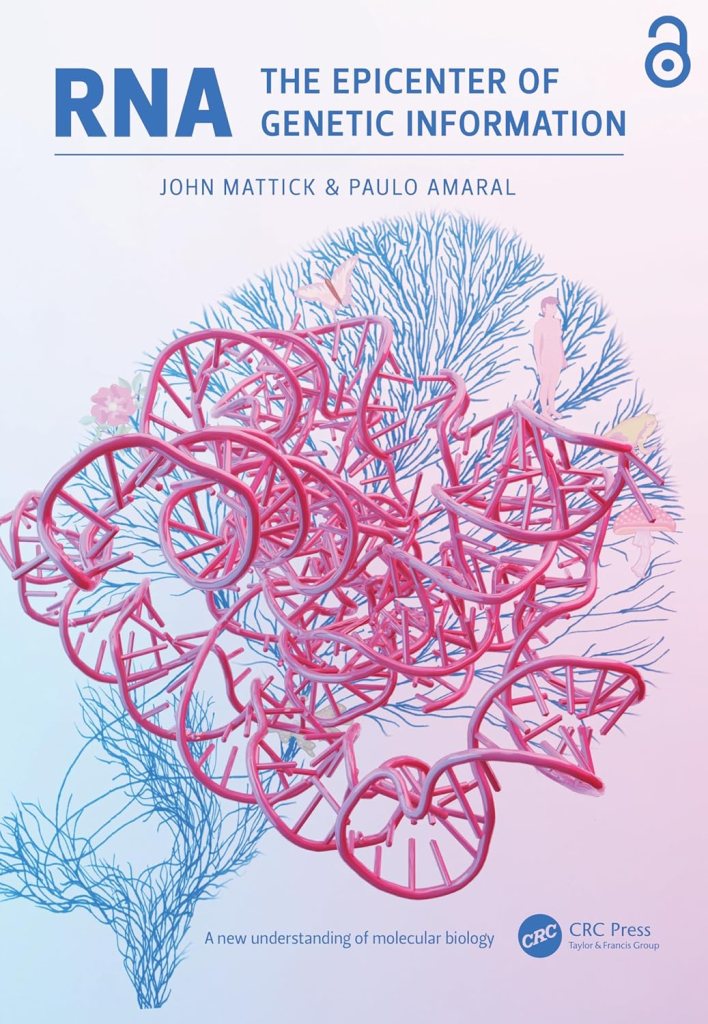
2. RNA, the Epicenter of Genetic Information — John Mattick, Paulo Amaral (2022)
Synopsis: RNA molecules are more than messengers and ribozymes. This is the story of how molecular biologist came to realise that small and long non-coding RNAs lie at the heart of all cellular processes. From regulation of genetic programs to association with chromatin, from epigenetic control to evolutionary innovations driven by transposable elements, this is a thesaurus for whoever approaches the field.
Authors’ bios: professors and researchers in RNA biology.
Related posts on WritinGenomics: “how many types of non-coding RNAs do you know?”
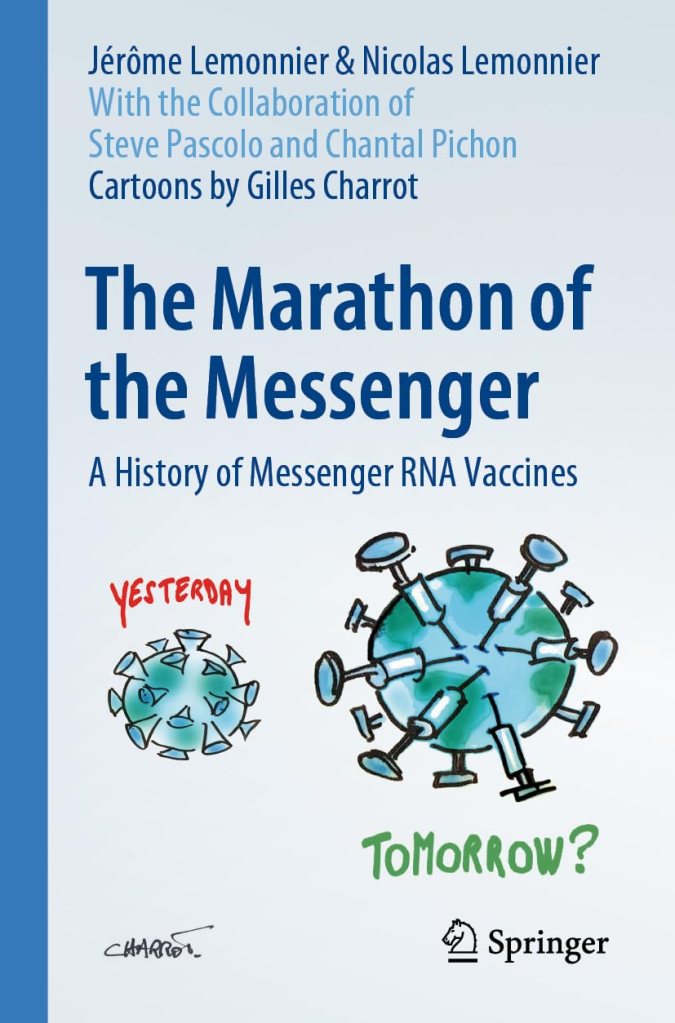
3. The Marathon of the Messenger —Jérôme Lemonnier, Nicolas Lemonnier, Gilles Charrot (2023)
Synopsis: BioNTech’s plan to develop a mRNA vaccine for COVID-19 was named “Project Lightspeed”. However, the first mRNA vaccine wasn’t the coronation of a breathtaking sprint, but of a 20-30 years marathon. With the help of humorous cartoons, we review the many discoveries, in Europe and in the USA, that led to this achievement., and its economic implications.
Authors’ bios: science enthusiasts, assisted by mRNA expert prof. Chantal Pinchon and dr. Steve Pascolo, former director of CureVec.
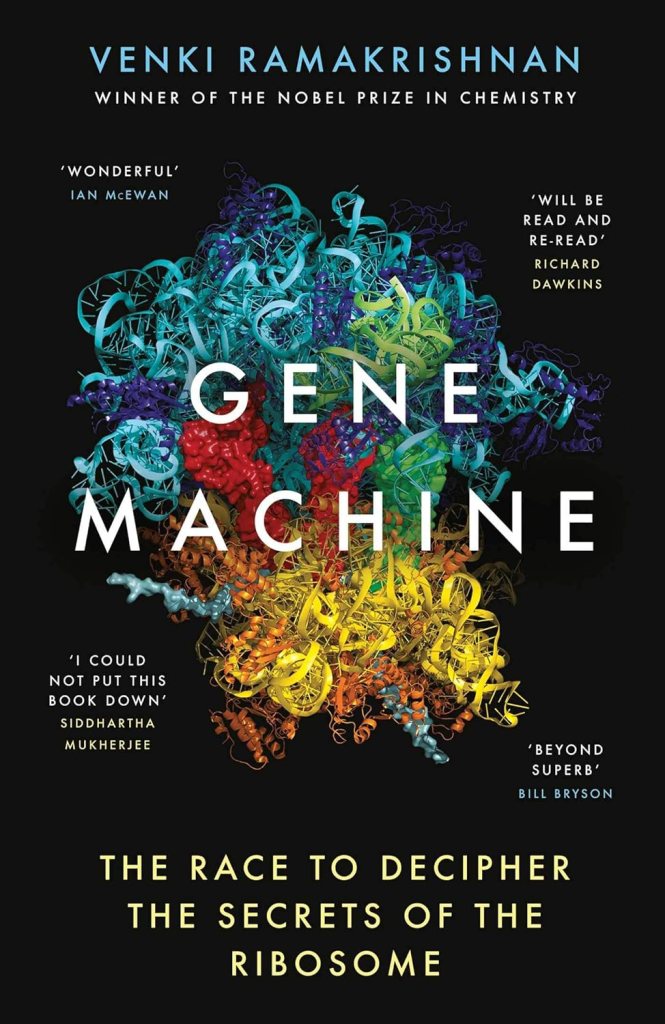
4. Gene Machine: The Race to Decipher the Secrets of the Ribosome — Venki Ramakrishnan (2018)
Synopsis: The ribosome is the king of ribozymes. Despite its 55 protein subunits, it’s the ribosomal RNAs (rRNAs) that catalyse the formation of the peptide bond between amino acids of growing proteins. In addition, it’s the rRNAs that mold the three pockets hosting the tRNA-amino acid complexes. Finally, it’s still the rRNAs that hold large and small ribosomal subunits together. This is an engrossing personal account of the competition to describe the structure of the ribosome, a colossal molecular machine with up to a million atoms.
Author’s bio: winner of the 2009 Nobel Prize in Chemistry for his work on the structure of the small ribosomal subunit.
Related posts on WritinGenomics: ribosomal RNAs.
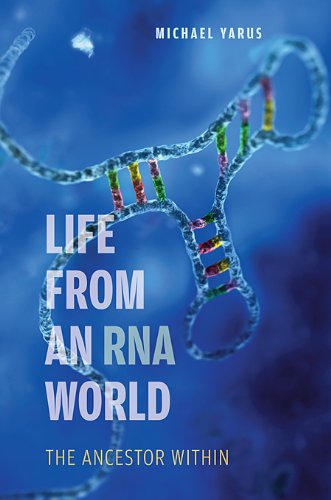
5. Life from an RNA World: the Ancestor Within — Michael Yarus (2011)
Synopsis: Tin the “RNA world”, the first living beings were made of RNA. Supporters of this hypothesis argue that RNA is the ideal starting block, in virtue of its ability to store information, like DNA does, and to catalyse chemical reactions, like proteins do. This book is a portrait of these ancestral RNA-based organisms — single cells named ribocytes — and an exploration of the molecular relics they left in the organisms of today.
Author’s bio: biologist, professor, educator.
To read more…
Looking for books on genetics? Check my 10 genomic reads for 2025!
Looking for SciFi novels? Check my list of 15 biotech/biology SciFi books of the past 25 years!
Looking to improve your writing? Check these six books to be a better (science) writer!
 WritinGenomics