This week, our journey in the ncRNAs universe explore the two players of the RNA interference (RNAi) pathway, and their close relative.
Let’s get going fellow travellers!
7. microRNA (miRNA)
They are ~22 nt long, and play a central role in regulating gene expression. This group of small regulatory RNAs is part of the RNAi pathway (along with endo-siRNAs).
miRNAs are frequently coded in introns, and less frequently exons, but some miRNAs are coded by dedicated genes. They are derived from single strand RNAs harbouring one or more short hairpins — multiple miRNAs are often part of the same transcript.
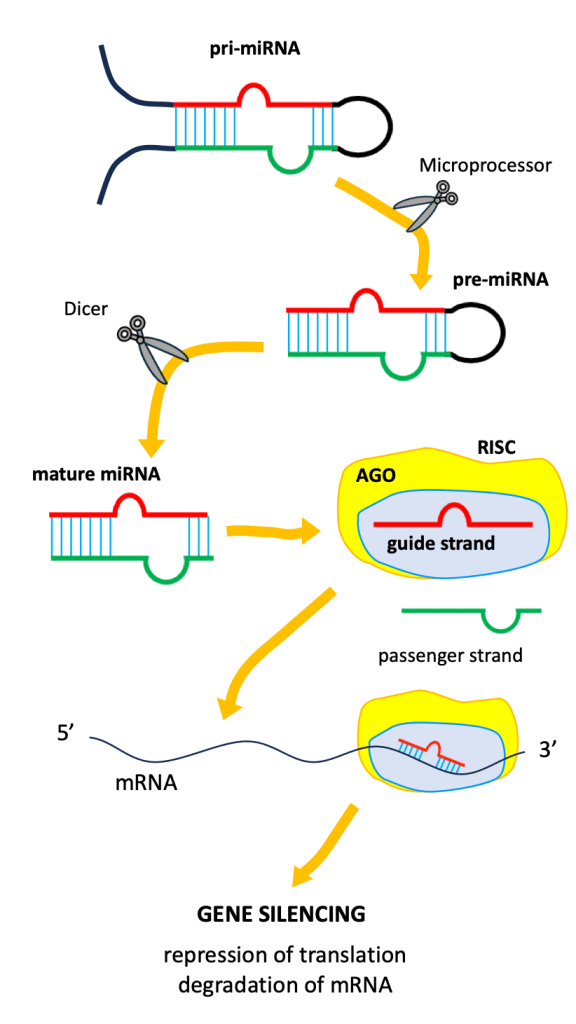
The biogenesis is a multi step process occurring in the nucleus and in the cytoplasm. Cells produce most miRNAs through the canonical pathway:
- In the nucleus, long primary miRNAs (pri-miRNAs) are processed by the microprocessor complex (Drosha + DGCR-8) into ~70-90 nt hairpins, the precursor miRNAs (pre-miRNAs). Pre-miRNAs are exported to the cytoplasm.
- In the cytoplasm, Dicer cuts the loop the hairpin off the pre-miRNA and releases two strands (5p and 3p). An Argonaute protein (AGO) binds the double strand RNA, but retains only one, the mature miRNA or guide strand, to form the RISC (RNA-Induced Silencing Complex). The other strand, the passenger strand, is unwound and degraded.
miRNAs play a pivotal regulatory role by repressing gene expression. They guide the RISC onto complementary sequences on the 3’-UTR of target mRNAs. If the match is partial, RISC blocks translation and destabilises the mRNA (more frequent in animals); if the match is perfect, RISC cuts the mRNA (rare in animals, frequent in plant).
For a review on miRNAs, see [1]. For an overview of the applications of miRNAs in medicine, visit my blog post on AMT-130, the gene therapy but UniQure that has slowed down Huntington’s Disease.
8. endogenous-small interfering RNA (endo-siRNA)
They are 20-24 nt molecules that protect the genome from RNA invaders and can regulate gene expression. This group of small regulatory RNAs is part of the RNAi pathway (along with miRNA).
They derive from long double strand RNAs (dsRNA) of different origin:
- transposons (genetic elements jumping from site to site in the genome),
- dsRNA viral genomes,
- long RNA hairpins,
- RNA transcribed from two opposing strands on the same genetic location (and therefore complementary).
Long dsRNA are processed by Dicer and loaded onto an Argonaut protein, forming the RISC complex. RISC is then guided onto RNA transcripts, resulting in their degradation upon perfect annealing to the endo-siRNA.
The main role of endo-siRNA is to protect cells from RNA invaders. While this RNAi pathway plays is important in arthropods (insects, spiders, crustaceans…), it is far less prominent than miRNAs and piRNA in mammals. Instead, mammalian cells respond to invasion by dsRNA elements with interferon. However, there are exceptions, such as mammalian embryonic stem cells, and mouse and rat oocytes.
For more details, refer to the excellent review in [2].

9. PIWI-interacting RNAs (piRNA)
These ~21-35 nt transcripts protect the genome of the germline – the cells that will produce egg and sperm cells – against transposable elements. Emerging evidence suggest an additional role in gene expression. piRNAs are a vast group that share similarities with miRNAs and endo-siRNAs.
Unlike miRNA and endo-siRNA, piRNAs are derived from long single strand RNAs, which are often transcribed from intergenic loci in the germline (piRNA clusters). These sequences can span hundreds of kilobases, are enriched with repetitive transposable elements and devoid of protein-coding genes. piRNAs from piRNA clusters prevent transposons from inserting in new sites in the genome, events that could otherwise cause catastrophic mutations.
However, some piRNAs derive from the coding region and 3’ untranslated region (3’UTR) of mRNAs [3]. These piRNA do not target transposons, but mRNAs. This observation, along with the finding that piRNAs are not expressed only in the germline, strongly suggest they perform additional functions, possibly regulating gene expression.
As piRNA precursors are single strands, they are not cleaved by Dicer, which only cuts double strand RNAs. Instead, other enzymes process them into primary piRNAs. Primary piRNA can then act on their targets directly or contribute to produce more piRNAs (called secondary piRNAs), an amplification process called “ping pong” cycle.
The biogenesis and mode of action of piRNAs requires association to PIWI proteins, members of the Argonaute/Piwi family (yes, the Argonaute proteins in the miRNA and endo-siRNA). Primary and secondary piRNAs are loaded into PIWI proteins, where they act as guides for the PIWI protein to find its targets.
- Post-transcriptional gene silencing (PTGS) in the cytoplasm: piRNA-PIWI complex lands on an RNA target and slices it off;
- Transcriptional gene silencing (TGS) in the nucleus: piRNA-PIWI complex lands on actively transcribed DNA. There, they recruit enzymes that methylate DNA and histones. Methylation changes chromatin structure from an open (easy to transcribe) to a close/compact (difficult to transcribe). As the chromatin becomes less accessible to the transcription machinery, gene expression is reduced.
To learn more, refer to [3] and [4].

WHERE ARE WE GOING NEXT?
In the next episode, we pay a visit to three new types of ncRNA:
- microRNA-offset RNA (moRNA)
- circular RNA (circRNA)
- small nuclear RNA (snRNA)
REFERENCES
- O’Brien et al. Overview of MicroRNA Biogenesis, Mechanisms of Actions, and Circulation (2018) Frontiers in Endocrinology
- Jouravleva, Zamore. A guide to the biogenesis and functions of endogenous small non-coding RNAs in animals (2025) Nature Reviews Molecular Cell Biology.
- LeThomas et al. To be or not to be a piRNA: genomic origin and processing of piRNAs (2014) Genome Biology.
- Sun et al. The birth of piRNAs: how mammalian piRNAs are produced, originated, and evolved (2022) Mammalian Genome.

 WritinGenomics
Leave a reply to How many types of ncRNA do you know? moRNA, circRNA, snRNA (Ep. 4/7) – WritinGenomics Cancel reply