Unroll our genome and you get a Michael Jordan! If we could unwind the 3.2 billion base pairs (bp) of our genome, it would stretch across 2 meters, 6 feet 6 inches, the height of the NBA icon. Humans pack a mind-blowing amount of DNA in their cells, and yet this is just a fraction of what true giants carry.
Mind you, the term giant doesn’t refer to body size. Enormous creatures do not sport a genome much larger than ours. For instance, a blue whale (the biggest animal on Earth) has a genome of 2.7 billion bp [1], and a sequoia (among the tallest trees) one of 8.1 billion bp [2]. Instead, genomic giants have bodies of unremarkable size, and yet the extension of their genomes is jaw-dropping.
Who are they?
THREE LARGEST GENOMES
Ten organisms have a genome surpassing 100 billion bp, that is 33 times larger than ours. Of these genomic giants, the three largest are plants. Small, unassuming plants that you could grow in your garden.
Let’s take a look:
3rd place: the long fork fern (Tmesipteris obliqua), with a genome of over 147.3 billion bp [3] or 46 human genomes. This plant’s genome unwinds over 97 meters, 319 feet, which is slightly taller than the Big Ben! This fern inhabits humid, shady environments in Australia, where its fronds grow up to 65 cm, 2 feet.

The long fork fern
2nd place: the Japanese canopy plant (Paris japonica), with a genome of 148.9 billion bp [4] or 47 human genomes. Its DNA stretches over 99 meters, 325 feet, which is taller than Michael Jordan on top of Big Ben! This one is a flowering plant growing in Japan’s mountains, where it reaches 80 cm, less than 3 feet.
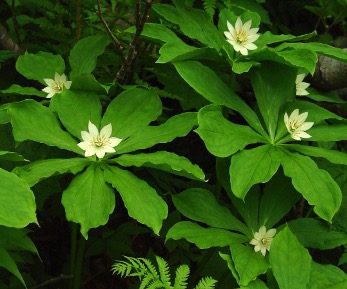
The Japanese canopy plant
1st place: as of May 2024, the title of giant among genomic giants belongs to another fern, the hanging fork fern (Tmesipteris oblanceolata subspecies linearifolia). Its DNA boasts 160.5 billion bp [5], or 50 human genomes. Such a giant spans 107 meters, 350 feet. That’s taller than a light pole on top of Big Ben! The tiny hanging fork fern lives in New Caledonia and neighbouring islands.

The hanging fork fern
BEYOND 160 BILLION BASE PAIRS
Is 160 billion bp the absolute ceiling or could another giant dethrone the hanging fork fern?
Well, we don’t know, but practical costs of a giant genome outweigh theoretical advantages.
Genomes balloon to giant sizes due to the accumulation of non-coding repetitive DNA and, in plants, to whole-genome duplications. While extra DNA repeats offer no benefit, an extra copy of the genome (polyploidy) might make a species more adaptable to changes—evolution can repurpose duplicated genes to new functions without losing current ones. However, evolutionary flexibility comes at immense costs of nutrients to build the genome and of energy to sustain DNA replication, transcription and repair [6]. As a result, genomic giants grow more slowly and are more sluggish than organisms with smaller genomes.
Yes, a genome can be too large, but living beings are full of surprises. Scientists remain on the hunt for a giant that pushes forward genomic boundaries and our understanding of biology.
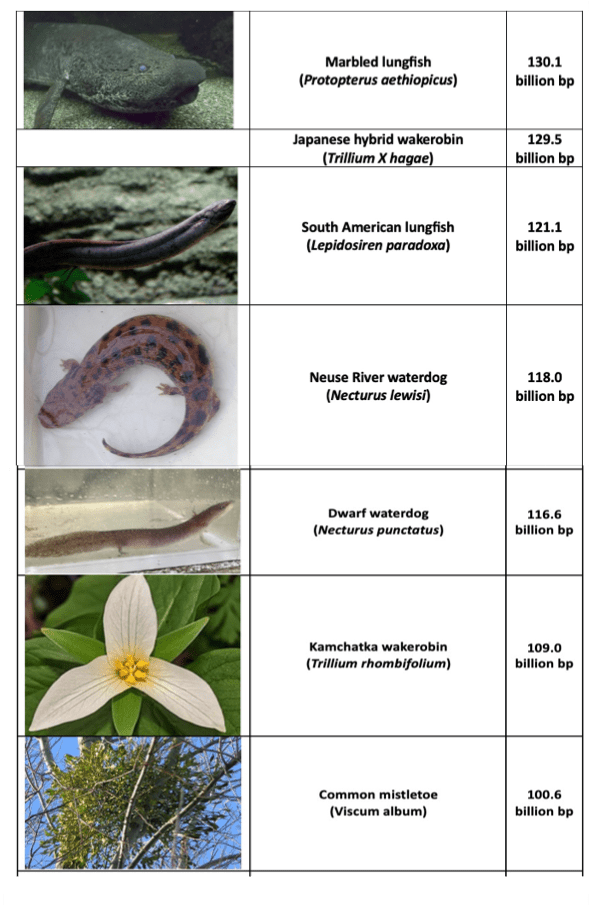
PS: here is the list of the other seven organisms with a genome surpassing 100 billion bp (adapted from [6]).
REFERENCES
1. Bukhman YV et al. High-Quality Blue Whale Genome, Segmental Duplications, and Historical Demography. 2024. Mol Biol Evol. doi: 10.1093/molbev/msae036.
2. Scott AD et al. A Reference Genome Sequence for Giant Sequoia. 2020. G3 (Bethesda). doi: 10.1534/g3.120.401612.
3. Hidalgo O et al. Genomic gigantism in the whisk-fern family (Psilotaceae): Tmesipteris obliqua challenges record holder Paris japonica. 2017. Bot. J. doi.org/10.1093/botlinnean/box003
4. Pellicer D et al. The largest eukaryotic genome of them all? 2010. Bot. J. doi.org/10.1111/j.1095-8339.2010.01072.x
5. Fernández P et al. A 160 Gbp fork fern genome shatters size record for eukaryotes. 2024. iScience. doi: 10.1016/j.isci.2024.109889.
6. Hidalgo O et al. Is There an Upper Limit to Genome Size? 2017. Trends Plant Sci.doi: 10.1016/j.tplants.2017.04.005.



 WritinGenomics