Author: Matteo Cortese, PhD
-
Six Books to Be a Better (Science) Writer
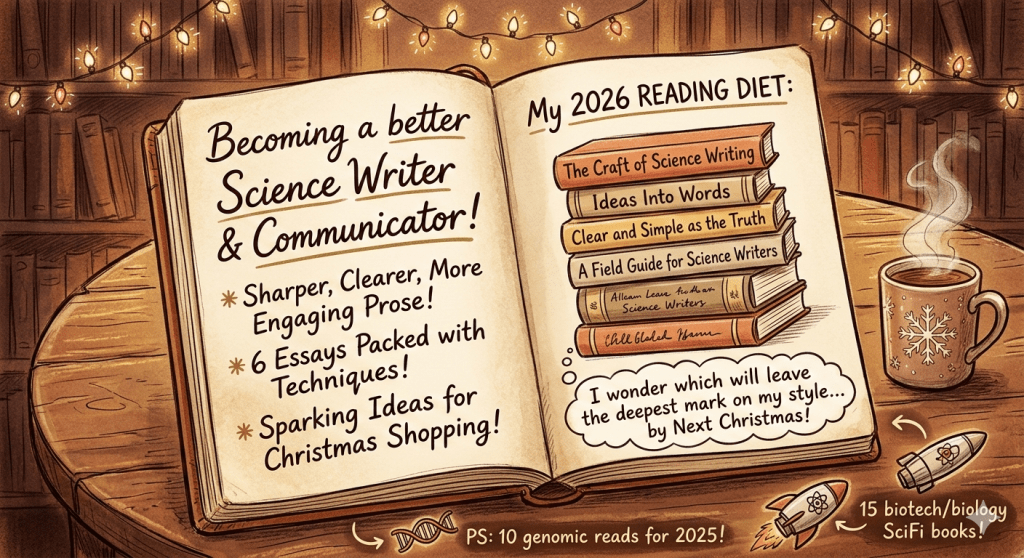
I want to be a better science writer and communicator – and my reading list might spark ideas for your Christmas shopping! I’ve just put together 6 essays packed with techniques to make your prose sharper, clearer, more engaging and memorable. These books are in my 2026 reading diet: I wonder which will leave the…
-
![1975 — Learning to Read DNA [A Chronicle of DNA Sequencing, EP3]](https://writingenomics.com/wp-content/uploads/2025/12/logo.png?w=956)
1975 — Learning to Read DNA [A Chronicle of DNA Sequencing, EP3]
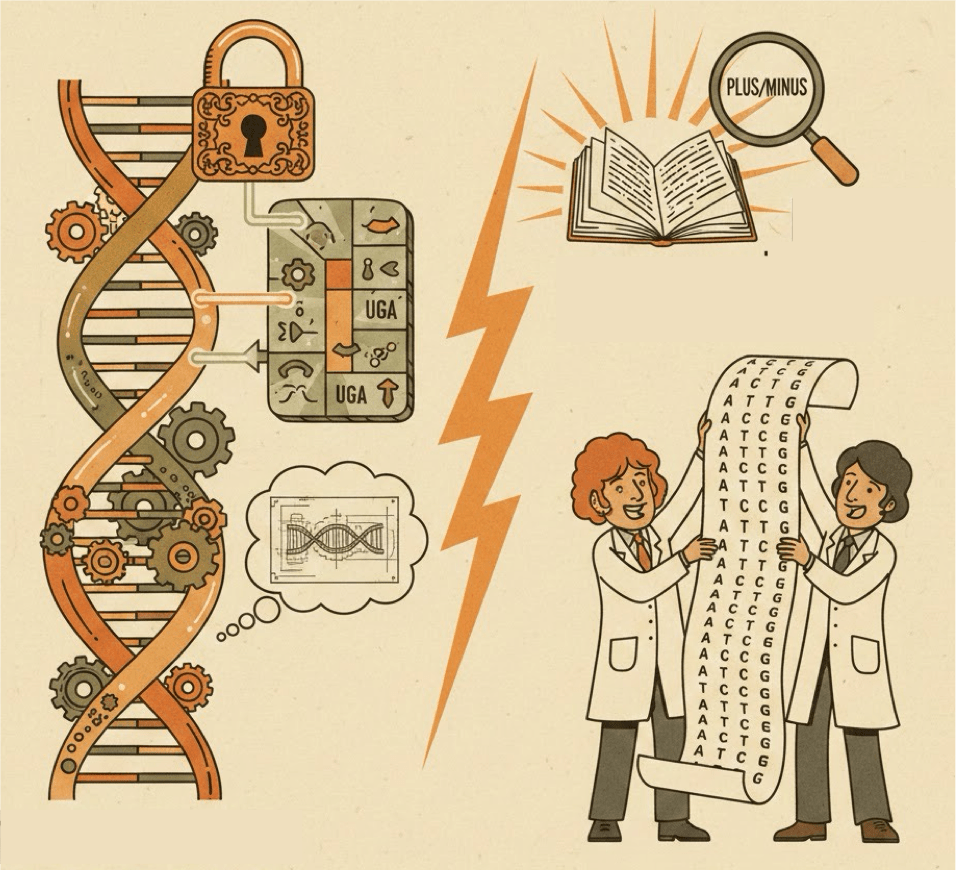
In the early 1970s, life scientists faced a paradox: they could interpret the language of the DNA, but they couldn’t read it. How could that be? Years of ingenious research had cracked the genetic code, revealing which nucleotide triplets code for which amino acid. This meant that scientists could predict a protein’s sequence from a…
-

𝗔𝗻 𝗮𝗻𝘁𝗶𝗱𝗼𝘁𝗲 𝘁𝗼 𝗿𝗼𝗺𝗮𝗻𝘁𝗶𝗰𝗶𝘀𝗲𝗱 𝘀𝗰𝗶𝗲𝗻𝗰𝗲 𝗶𝗻 𝟱 𝗱𝗼𝘀𝗲𝘀
I’ve been in science for a third of my life, at world-class research institutes and now in the biotech industry. Over this time, I have run into 5 romanticised misrepresentations of what science is and who scientists are. I have listed these myths below, let me know what you think! Dose 1: Science is a…
-

10 Genetic Disorders with Bizarre Names
From werewolves to men made of stones, some genetic disorders have not just puzzled scientists and doctors in recent times, but they have also caught the imagination of laypeople through the centuries. This is a list of 10 genetic disorders with bizarre common names, usually given because of a weird, and often life-threatening if not…
-

The Worst Nobel Prize Ever
In science, the worst Nobel Prize ever awarded must be the 1949 one in Physiology or Medicine, which went to Antonio Egas Moniz for the invention of frontal leucotomy. If you haven’t heard of leucotomy before, it’s because this procedure is better known with another name: lobotomy. In the 1930s, Moniz had developed this surgical…
-

Adieu Copy-Paste: A Brief Guide to Making the Em Dash
This post is a little different from the others. I am taking a brief detour from genomics here – no non-coding RNAs, no misconceptions in genomics, no history of DNA sequencing. This post explores the other side of my blog, that is writing. Specifically, I have a writing tip to share. Not a sweeping piece…
-
![1965 — Deciphering the Code of Life [A Chronicle of DNA Sequencing, EP2]](https://writingenomics.com/wp-content/uploads/2025/10/picture-1.jpg?w=309)
1965 — Deciphering the Code of Life [A Chronicle of DNA Sequencing, EP2]
Life doesn’t have an alphabet, but two: that of DNA and that of proteins. The genetic code is the Rosetta stone of molecular biology: it lays out how cells convert one alphabet into another — three bases into a single amino acid, but never the reverse. These rules were first summarised in a historic chart…
-

Save your PhD/PostDoc Before Stepping Foot in the Lab: Visit PubPeer
Here you are, ready to start a PhD or a postdoc. Maybe you are weighing your options, asking yourself questions – which lab should I join? How fast will I publish? Are my papers gonna land in journals with a high impact factor? – whose answers may very well steer your life in one direction…
-
![moRNA, circRNA, snRNA [How many types of ncRNA do you know? Ep. 4/7]](https://writingenomics.com/wp-content/uploads/2025/09/ep-4.png?w=1024)
moRNA, circRNA, snRNA [How many types of ncRNA do you know? Ep. 4/7]
This week, our journey in the ncRNAs universe brings us back to miRNAs before moving to splicing and the RNAs that make it possible. Let’s get going fellow travellers! 10. microRNA-offset RNA (moRNA) These ~ 20 nt long transcripts are coded in the regions of the pri-miRNA directly flanking the pre-miRNA. They were initially considered…
-

Treating Huntington’s Disease and Beyond: Three Applications of miRNAs in Gene Therapy
A microRNA (miRNA) is on the news since Wednesday; many just haven’t been told. I am referring to AMT-130 by UniQure, the gene therapy slowing the progression of Huntington’s disease [1]. In a nutshell, the miRNA in AMT-130 reduces the level of the protein huntingtin in neurons, which a mutation has turned toxic in Huntington…